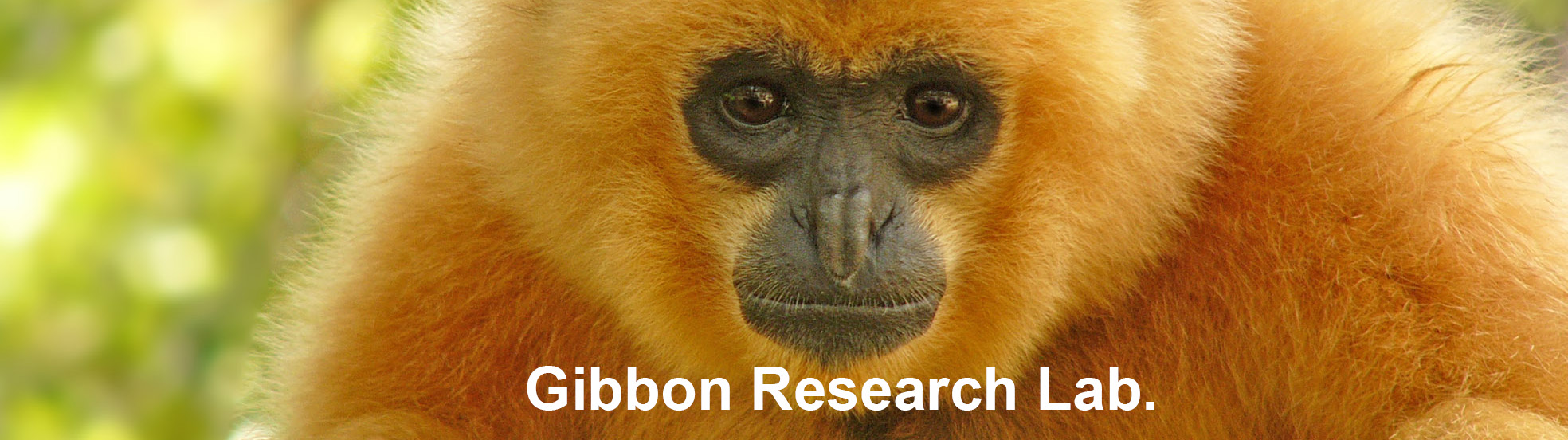

White-cheeked crested gibbon (Nomascus leucogenys) female

proudly presents:

Banner Gibbon Research Lab.

Welcome

Welcome to the website of the Gibbon Research Lab., owned by Thomas Geissmann. Do you want to know more about gibbons? This is the place you need to visit.

The Gibbon Research Lab. is active since 1980 and is currently located at the
Anthropological Institute of Zürich University (Switzerland). Click here for information on how to find us. Our research activities are covering the whole biology of the gibbons or small apes (Hylobatidae).

The Gibbon Journal: Sixth issue available

Gibbon Journal No. 6: Cover

The Gibbon Journal publishes original papers in English or German on all aspects of gibbon natural history. It is distributed electronically and published annually by the Gibbon Conservation Alliance (www.gibbonconservation.org).

The sixth issue of the Gibbon Journal is available now.
MORE

Contents

Press a button to jump to the desired page:
Brief introduction to the natural history of the gibbons
  Introduction to gibbon systematics
  Photographs of all gibbon species
  Sound samples of all gibbon species
  Video samples of gibbon behaviour
  News section presenting the latest information on gibbon biology and conservation
  Complete list and abstracts of all our publications
  Full texts of several of our publications
  Theses produced by members of the Gibbon Research Lab.
  Links to other gibbon-related sites
  Links to the members of the Gibbon Research Lab. and instructions on how to find us

Book Releases

Hoolock gibbon and biodiversity survey and training in southern Rakhine Yoma, Myanmar: Preliminary report
by Geissmann, T., Grindley, M., Momberg, F., Ngwe Lwin, and Saw Moses

2008, 31 pages, 17 figures.
Myanmar Primate Conservation Program, BANCA, FFI, PRCF and Yangon University, Yangon, Myanmar.
MORE

Status Survey and Conservation Action Plan for the Hainan Gibbon - Version I (Last Updated November 2005)
by B.P.L. Chan, Fellowes, T. Geissmann, and J. Zhang (eds.)

ISBN 962-8869-27-2, 2005, iii + 33 pages, 4 figures.
Kadoorie Farm & Botanic Garden, Hong Kong SAR.
MORE

Vergleichende Primatologie
by Thomas Geissmann

ISBN 3-540-43645-6, 2003, Cloth, 357 pages, 210 figures.
Springer-Verlag, Heidelberg & New York.
MORE

Verhaltensbiologische Forschungsmethoden: Eine Einführung
by Thomas Geissmann

ISBN 3-934849-64-4, 2002, Paperback, 60 pages, 11 figures.
Schüling Verlag, Münster, Germany.
MORE

Vietnam primate conservation status review 2000, Part 1: Gibbons
by T. Geissmann; Nguyen Xuan Dang; N. Lormée and F. Momberg

ISBN 1-903703-03-4, 2000, Paperback, 130 pages, 9 figures, 7 colour plates.
Fauna & Flora International, Indochina Programme, Hanoi, Vietnam.
This book can be freely downloaded
HERE.

Research Projcts

Our primary research interests are focussing on the utilisation of a comparative approach to investigate various aspects of social behaviour such as communication, social organisation, and reproductive patterns in gibbons and other primates, with an emphasis on the evolutionary significance of these factors.

We have a special interest in the vocalizations of the gibbons, and many of our publications describe the variability, function, inheritance and evolution of the gibbon vocal repertoire.

Gibbons form strong pair bonds which usually last many years. We are interested in elucidating the proximate and ultimate mechanisms of pair bond formation, maintenance, and differences among gibbon species.

In an other ongoing project, comparative DNA analysis is being undertaken in order to elucidate evolutionary relationships among gibbons and other primates. In other research projects, the comparative approach is applied to gain further insight into systematics of the entire primate order, and in the evolution of communication within the order, including the origin of music in humans.

We have a special interest in the conservation of endangered gibbon species. Gibbons include some of the most endangered primate species. Several of our publications address conservation issues (see list of publications) and we carry out gibbon status survey all over the gibbons' distribution area.

A major project involves a comprehensive revision of the systematics of the crested gibbons (Genus Nomascus), a survey of the major populations in the field with an assessment of their status, and the creation of an action plan for crested gibbon conservation which will be submitted to international organisations for wildlife conservation. To date, several field surveys have been carried out in Cambodia, China (Yunnan Province and Hainan Island), Laos and Vietnam.

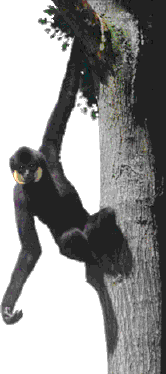
Yellow-cheeked crested gibbon (Nomascus gabriellae) male

White-cheeked crested gibbon (Nomascus leucogenys) family group

Are you interested in gibbon research?

Students and scientists interested in participating in our research group are kindly invited to contact us at the address provided below. A number of short-term and long-term research projects both on wild and on captive gibbons are available to interested students and researchers who are able to provide their own funding.

We are always happy to learn more about gibbons. Everybody having observed unusual gibbon behavior or having tape-recorded interesting gibbon vocalizations of captive or wild gibbons is welcome to contact me:

PD Dr. Thomas Geissmann
Anthropological Institute
University Zürich-Irchel
Winterthurerstrasse 190
CH - 8057 Zürich
Switzerland

Phone: +41 - 1 - 635 54 13
or: +41 - 1 - 635 54 11
Fax: +41 - 1 - 635 68 04
E-mail:
webmaster@gibbons.de

Banner Gibbon Network

Logo Gibbon Conservation Alliance

Please also visit the website of the Gibbon Network. It is a companion site to the Gibbon Research Lab. and is frequently updated. It serves to connect people interested in gibbon conservation and reseach. It offers a list of field sites in South-east Asia specializing in gibbon research and reintroduction, a survey of the zoo gibbon population, information on gibbon studbooks, a list of ongoing or recently completed gibbon-related projects, a list of the most recent publications and theses on gibbons, and gibbon fact sheets. Please also visit the website of the Gibbon Consercation Alliance. The Gibbon Conservation Alliance is a non-profit organistion dedicated to gibbon conservation and research on gibbon biology. In addition, the GCA aims at increasing the presence of gibbons in the media and provides information on gibbons, the threats to their survival and the relevance of gibbon conservation.

Pictures on this site copyright by Thomas Geissmann, unless noted otherwise.